
Guide
Tasting games for adults: seven blind taste tests that work at a party
Search for a taste test game and you get blindfolds, children and a bowl of jelly beans. The grown-up version needs none of that. Hide the labels, number the samples, make everyone write a guess down, and almost anything in the kitchen becomes a game with a winner.
These are seven that work at a table, from a packet of chips to a bottle of wine, with the rules that keep them fair. The last one is the one you can order already hidden.
What makes a tasting game work
A tasting game is a blind taste test with a score. Everyone tastes the same numbered samples at the same time, nobody knows what they are, and every guess is written down before the reveal. Then the reveal, one sample at a time, and a point for each guess that was right.
Blind means the labels are hidden, not the eyes. Colour is part of the guess, nobody has to be fed by a neighbour, and nobody is put on the spot while the table watches. It works sitting down, it works for the friend who knows nothing about the thing being tasted, and it ends when the host says so.
Seven blind taste tests
1. Chips: one flavour, three brands
Needs three packets of the same flavour and three numbered bowls.
Pick a flavour most brands make, like salt and vinegar, and tip each packet into a numbered bowl out of sight. Everyone tastes all three and writes down which brand they think each one is, and which they liked best. The shape of a chip gives a brand away before the tongue does, so break them into similar pieces first.
2. Chocolate: cheap, middle, dear
Needs three slabs of the same kind of chocolate at three prices, broken into plain squares.
Everyone ranks the three from cheapest to dearest, then votes for the one they would buy. Keep the ranking and the vote separate: they do not have to agree, and when they do not, that is the conversation. Serve the squares at room temperature, not from the fridge.
3. Soft drinks: match cup to brand
Needs three colas, or three waters, in identical numbered cups.
The classic. Pour three colas, or tap water against two bottled ones, at the same temperature into cups that look the same. Everyone matches cup to brand on paper and locks it in before the reveal. Try the water round if you want an argument.
4. Coffee: find the instant
Needs three coffees made the same strength, served black.
One of the three is instant and one cost the most. Everyone names which is which from numbered cups, black, before the milk goes anywhere near it. It works with tea too: three brands, the same steep, milk only after the guess.
5. Cheese: pick from a list
Needs three cheeses cut into equal cubes, and a list of their names.
Number the cubes and show the table the three names in the wrong order. Everyone matches cube to name. Giving the options is what makes it work for people who do not know cheese: the game is matching, not knowing.
6. Beer: name the style
Needs three or four beers of different styles and identical glasses.
Pour a lager, an ale, a stout and one oddball out of sight into glasses that look the same, numbered. Everyone writes the style for each, and a brand if they dare. Mix the ordinary with the odd, so there is something to be surprised by.
7. Wine: the blind tasting
Needs two or three bottles, a sock or paper bag per bottle, and a pen or a phone each.
Take the foil off the neck, cover each bottle, number it, and write the answers down where nobody can see. Chill the whites 20 to 30 minutes before you start and taste light to heavy. Ask the same questions every round: colour, smell, taste, grape, vintage, region, price. Each bottle is a round of about 20 minutes, and the reveal, one bottle at a time, is the best part of the evening.
The rules that keep it fair
These seven rules keep any of them fair. Skip one and the argument at the reveal is about the rules instead of the guesses.
- One thing, one difference, for the food and drink rounds. Three brands of one flavour, or one chocolate at three prices. Change two things at once and nobody knows what they were guessing. The wine round is the exception: the bottles differ in everything, which is what its questions are for.
- Serve each sample the same way to everyone: same portion, same cup or glass, numbered. Samples being compared with each other go out at the same temperature; in the wine round the whites go in the fridge and the reds are served just below room temperature, so pour each bottle at its own. Cover the labels before anyone arrives.
- The host writes the key down where nobody can see it. The host is allowed to know; if you would rather play too, get someone else to do the hiding.
- Talk first, then commit. Everyone writes a guess down before the reveal, and nobody changes it after. The argument is the fun part; a guess changed once the answer is out is not a guess.
- A sip of water between rounds resets the palate.
- One point per correct guess, per sample, and reveal one sample at a time with a running total. In a homemade round you can add a bonus point for the harder detail, like the brand of a beer as well as its style.
- Keep rounds short: a minute or two for a chip, about 20 minutes for a wine. The game ends when the host says so, not when the rules do.
Why the wine one is the keeper
The food rounds are five minutes of fun each. The wine round is an evening. There are seven things to guess instead of one or two, it happens in the glass you were already holding, and the reveal lands bottle by bottle with the table arguing before the sock comes off. The friend who reads wine lists for fun and the friend who orders “the red one” start level, because nobody has seen a label. About 20 minutes a bottle, so two wines is a relaxed 45 minutes and three is close to an hour.
The host guide has the whole method: how many wines, how to hide the labels, what to ask and how to score it. If the tasting is one game among several, the dinner party games guide says where each one belongs in the evening.
The one that arrives already hidden
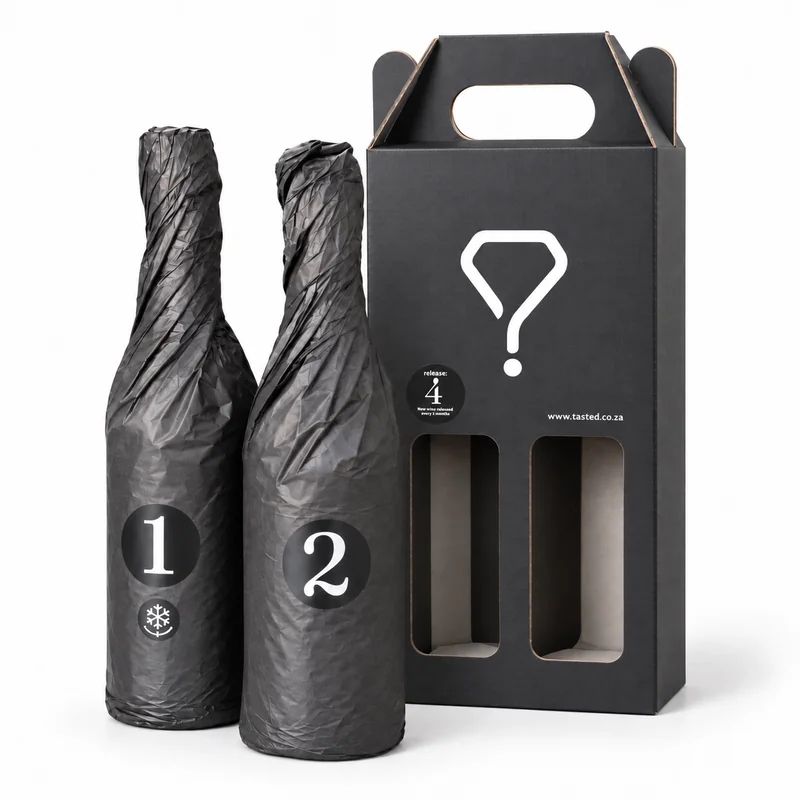
A Tasted box is the wine round with the admin done. Sealed, numbered mystery wines come in the box with a QR code to join. Everyone joins the game on their own phone with the QR or the game code, no app to download, and the questions, the scoring, the reveal and the winner happen on screen. The Discovery Box has two wines, the Premium and Reserve boxes have three, and one box is made for 2 to 10 players. Boxes start at R365. Delivery is R65 across South Africa, free on orders over R1000.
Not sure what you like? The quiz is nine questions and points you to a South African bottle you would never have picked yourself.
Questions people ask about tasting games
What is a tasting game?
A blind taste test with a score. Everyone tastes the same numbered samples without knowing what they are, writes a guess down before the reveal, and gets a point for each one right. Chips, chocolate, coffee, cheese, beer and wine all work. The labels stay hidden; the eyes stay open.
How do you do a blind taste test at a party?
Pick one thing and change one variable: three brands of the same chips, or one chocolate at three prices. Serve every sample the same way, at the same temperature, in numbered cups, bowls or glasses. Let people talk, then everyone writes a guess down before the reveal and nobody changes it after. Reveal the samples one at a time.
Do you need blindfolds for a tasting game?
No. Blindfolds are for the children’s version. Adults keep their eyes open and the labels hidden: tip chips into numbered bowls, break chocolate into plain pieces, pour drinks out of sight or cover the bottles. Colour is part of the guess, especially with wine.
How many samples should a tasting game have?
Three to five for food and soft drinks; palates tire fast. For wine, two or three bottles: each one is a round of about 20 minutes, so three bottles is roughly an hour of play.
How do you score a blind taste test?
One point per correct guess, per sample. Reveal one sample at a time and keep a running total; whoever has the most points at the last reveal wins. In a homemade round you can add a bonus point for the harder detail, like the brand of a beer as well as its style. In the Tasted game the phones keep score, and every guess is locked before the reveal.
Can beginners play a wine tasting game?
Yes. Nobody sees a label until the reveal, so the friend who reads wine lists for fun and the friend who orders the red one start level. The questions are about what you can see, smell and taste.
How many people can play a tasting game?
Any number can play the food rounds. For the wine game, one box is made for 2 to 10 players; a tasting pour is small, so one box pours for a table of 10. For a bigger crowd, order a box per table.